
Can you help (spread betting) Joe?
Or any of your friends from getting sucked into this hideous gambling activity?

Written for wannabe ‘day traders’ worldwide – whose lives are destroyed by spread betting and other gambling activity.
This Insight aims to help anyone (like our fictional character Joe, here) to understand the real and horrendous risks of spread betting before it’s too late.
Please share with your friends.
How can this still be happening?
The fact is that most people lose money on this ‘trading’ game.
Thankfully, the UK’s Financial Conduct Authority (the FCA) published a major review of spread betting and CFD products in January 2018 after a 12 month investigation.
And, unsurprisingly, it found widespread problems.
The FCA described the market as posing a serious risk of consumer harm – and then imposed various new rules in August 2019, including leverage caps and negative‑balance protection.
So, on UK‑regulated retail spread‑betting accounts, losses are now limited to the funds in the trading account.
Spread bet providers must now also disclose the proportion of users who lose money on their platforms, and the numbers typically show it’s between 70% and 80%!
Do these steps do enough to protect people from harm?
It seems not because up to 80% of the ‘betters’ still lose money.
The risk warnings are not clear enough. So, I share this post to correct that.
And let’s be very clear. The problem is not just that most people lose a bit of money.
Many of the people who ‘trade’ (Spread Bet) lose everything they put into these accounts.
What’s more, if you’re able to set up an Offshore (non-UK-regulated) or ‘professionals’ account, you could expose yourself to losing far more than 100% of your stake in this trading game.
Read Joe’s story below to find out more
This is Joe’s story
Joe is 31 years old – and works as an Insurance Sales Rep for one of the big firms in London.
He’s married to Naomi. They have a four-year-old son, Luke – and another on the way.
So, they’re keen to move out of their two-bed rented flat and buy a three-bed house for their growing family.
They both have well-paid jobs but their cost of living is high and they only manage to save modest amounts each month.
They don’t yet have enough for the deposit on their dream home. They have joint savings of £20,000 and need around £40,000 as a deposit on their new home.
Joe knows that home prices have softened recently, but that they rose significantly over the past 15 years.
So, their savings have not kept pace with the rising deposit amount they need – and they’re frustrated that their chances of ever buying are slipping away.
Joe takes advice from his mate Phil
One of Joe’s work friends, Phil, has said many times that he’s made a lot of money with some simple trades in the markets.
Joe knows that Phil is not rich, so he’s obviously not making a fortune at this.
And Phil doesn’t have children, so perhaps he can afford to fritter away his spare income.
Joe also suspects that this trading game might be risky, but reckons it’s OK to check it out. After all, it might help them build that £40,000 they need as a deposit – in double-quick time.
Phil assures Joe that his trading isn’t risky because you can set stop-loss orders on your trades if you’re nervous.
“Stop loss orders only cost a small percentage,” says Phil, who suggests setting a stop loss at 2% on the price of the shares Joe wants to trade.
Phil also says it’s easy to set up a trading account, get started with a modest sum, and trade online from home.
But Joe is still nervous, so he does some homework before ‘signing up’.
What is gearing – and is it really a good thing?
Joe discovers that spread trading is ‘geared’ and needs to know exactly what this means.
There’s a mass of information on the trading websites, but it’s all extremely dull and confusing.
So, as he does with most things, Joe searches on YouTube for a short lesson and soon finds this basic training video which enhances his confidence.
See here
As it says on the video, “gearing is good”!
So that must be right – because you can’t mislead people on YouTube, can you? 😉
‘So far so good,’ thinks Joe, ‘this sounds like what we need to build those funds for the house.’
That lady sounded confident – and she explained the concept well.
BTW: Companies that (falsely) promise to teach you ‘how to get rich’ by spread betting often use young attractive women for marketing because their most likely ‘users’ are young men.

So Joe sets up an account to start spread trading
He decides not to tell Naomi as he doesn’t want to worry her.
In any event, she might put the brakes on the idea – she can be a bit like that sometimes!
Joe decides to place a trade on the shares in a mid-sized fast-growing engineering company that he’s familiar with.
He was thinking of buying shares in that company anyway and this seems like a great way to magnify his profits.
So, he places his first trade as an ‘up bet’ at £100 per point.
What’s a ‘point’?
In this case, a ‘point’ is a one-penny move in the share price – which currently stands at 1,000p.
With spread betting, you can make either up or down bets depending on which way you think prices will move.
There are, naturally, charges (bid to offer spreads) on these accounts and the price needs to move by more than the ‘spread’ in prices (in the right direction) to start making any profit.
But we’ll ignore these charges in this simple example.
Joe’s trading account informs him that to make this trade, he must deposit a ‘margin’ payment of £20,000.
This is based on a 20% margin of the value of Joe’s market exposure of £100,000.
And that maximum loss of £100,000 is Joe’s £100-per-point bet multiplied by 1,000 (the maximum number of points the share price could fall if it collapsed to zero).
As a retail client (trading on a UK-regulated platform), however, Joe has negative-balance protection.
So, in the worst case (and unlike the position before 2019), he cannot lose more than his account balance.
Just be aware, he can still lose 100% of what he put in!
Joe bets it all
Now, £20,000 is everything that Joe has in his savings account with Naomi.
So he thinks carefully before going ahead – by talking it over with Phil – over several beers.
Joe then decides to move their £20,000 into the spread betting account to cover his first trade.
He puts a 2% stop loss in place to prevent any nasty losses, and then it’s done – Joe’s first trade is on.
- ‘This is fine’, thought Joe, ‘I’ll sell out of this trade once the price rises by about 10% to 1,100p.
- ‘And that’s a perfectly reasonable bet… given that the price fell by nearly 10% yesterday’ …
- ‘And everyone knows prices always bounce back after big falls‘
He’s also worked out that a 10% price increase would deliver about £10,000 of profit (a 100-point move times £100 per point)
And this would put him and Naomi well on their way to getting their new home.
So, after setting everything up and reading around the site a bit more (over more beers into the small hours)… Joe crawls into bed, where he struggles to fall asleep – because he’s quite excited about this trade.
The very next day
Unfortunately, just before the markets open the next morning, the company on which Joe has placed his bet issues a profit warning, and the price is marked down significantly at the open.
Joe can’t believe his eyes – the price has fallen like a stone.
It’s down 20%!
‘Crikey’, thinks Joe. ‘This is bad – really very bad.”
He takes a deep breath and starts to consider how he’s going to break this to Naomi.
Then he remembers…
‘It’s okay. I have a stop loss on that trade at 2%.
Thank goodness for Phil’s advice on stop-losses – we’ll be fine.’
Joe first thinks a 2% stop on his £20,000 deposit means a £400 loss.
He then realises the stop applies to the share price, not his deposit.
A 2% fall from 1,000p is 20 points. At £100 per point, that’s a £2,000 loss, plus charges.
So, Joe considers closing the account immediately to prevent any more losses, but then he doubles down…
“What’s the point of closing the account now?” he thinks,
“That was simply the first trade and I got really unlucky.
I’ll soon make up for that loss on the next trade.
Lightning never strikes twice in the same place – right?”
The Call
Just then, Joe gets a phone call from the spread trading company, asking what Joe wants to do with his account.
‘What do you mean?’ says Joe.
‘No, of course I don’t want to close the account, I want to put on another trade – do you think I give up that easily?’
The man on the phone tells Joe that he needs to close his account. Or, to place more trades, like before, he’ll need to add in another £20,000.
‘What… how on earth can that be?’, demands Joe,
‘I put £20,000 in that account, and with my 2% stop loss, I reckon I’m down about £2,000.
‘Why is there nothing left?’
‘This is because the share priced ‘gapped’ overnight – and opened 20% lower today’, said the man.
Mind the gap
Joe has no idea what “gapping” means so the man explains.
“Gapping is a sudden shift in the price from one level to another.
It can happen during a trading day or overnight when markets are closed, as happened here.
And when the market opened this morning, the price was already 20% down.
So yes, your stop-loss sell order triggered, but I’m afraid it did so at a much lower price than you were expecting.’
‘Hang on’, says Joe.
‘Are you seriously saying that a ‘stop-loss’ doesn’t stop losses when CRAP happens?‘
‘Well yes‘, replied the man.
‘You could have bought a guaranteed stop loss – which would have protected you from this gapping problem.
But those stop orders have higher charges, which eat into your trading profits, so few people use them, but obviously they’re worth it in these situations.
The details are all clearly marked on our site for you to read.’
Joe is shocked, stunned and silent
The man pipes up again.
“So in the meantime, you just need to deposit another £20,000 to do a similar deal – or close down your account…
Joe only now realizes just how stupid he’s been.
To begin with, he’d thought that he was only risking about £400 (The 2% stop loss on £20,000)
Then, when he did the sums again, he thought he’d lost perhaps £2,000 worst case – because of the 5 times gearing on his return.
And now, because of the price crash overnight, it turns out he’s lost £20,000 in just one night.
Their entire life savings was gone on this mad experiment.
What is he going to tell Naomi?
And what about Phil?
Phil had traded actively for years, had built a substantial portfolio of cash and investments, and worked in a financial-services role that gave him relevant experience.
So, he was able to meet the spread bet platform’s test for elective professional‑client status.
And he grabbed this with both hands because the ‘professionals’ account required a lower-margin (deposit) which meant he could place much bigger bets without tying up so much money.
The only problem was that in switching up to this account he lost something called ‘negative-balance protection’ – which prevents people from losing more than their initial stake.
And sadly, Phil, put a large trade on a share that also ‘gapped’ down overnight – which sent his account from £50,000 in credit – to a debt of £40,000.
Yes, that can and does happen with spread bets – in professional (or non-UK regulated) accounts.
So, is that the end of the story?
Well it’s the end of the story about Joe and Phil – but not the end of this Insight on the risks of spread betting.
And yes, I accept it’s an ‘extreme’ story – designed to ‘hammer home’ a critical point.
But make no mistake, these sorts of losses are happening, a lot, across the world – and destroying thousands of peoples lives.
And yes – the price of big company shares can gap by this amount and more!
For example, on the night of 21/22 November 2011, the share price of the holiday company Thomas Cook Group fell by over 50%.
And ironically, after the announcement of Thomas Cook, the shares in spread betting provider IG also crashed by c. 40% in a single day.
But most losses don’t happen this way
You don’t need the bad luck of price ‘gapping’ to lose a lot of money on spread bets.
It’s perfectly possible to lose money at the rate of, say, 10% of your stake – on each bad trade.
Either way, most people do lose money on spread betting – as you can see from the banner on any spread betting site.
You just need to be aware that some people are losing all their money on those bets – which is all they are.
Only a small number of people win over the medium term, and there’s no evidence (that I’m aware of) to show that those winners had anything other than good luck!
All you can know for sure is that you’ll only hear the ‘winners’ bragging about their experience in this super high-risk game.
The psychologists call this ‘survivorship’ bias.
The losers (and there are a lot of them) tend to keep quiet 😉
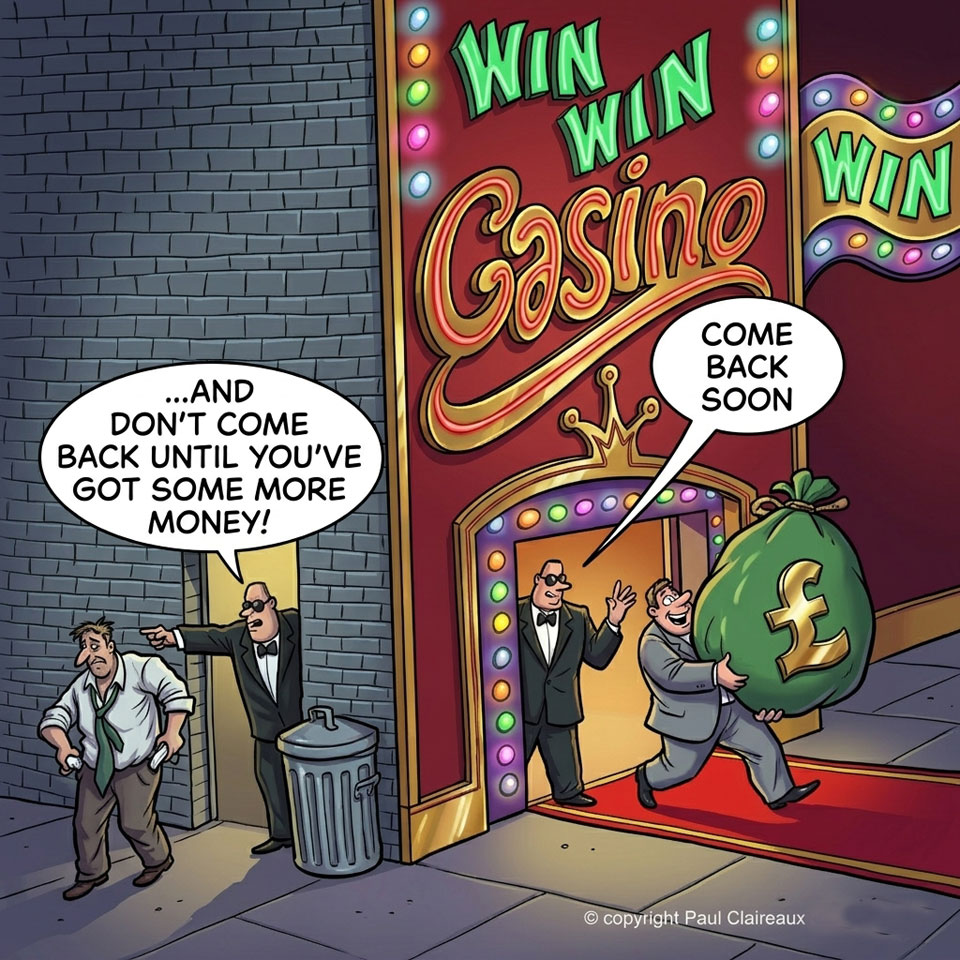
Have you heard about Sean Quinn?
Sean Quinn was an Irish businessman, and in 2008, he was the richest person in Ireland.
The Sunday Times Rich List estimated his personal worth to be €4.722 billion (£3.73 billion).
According to the BBC, between October 2005 and July 2007, Sean Quinn had built up a 28% stake in the former Anglo Irish Bank using Contracts for Differences (Spread Bets for Rich People) to gamble on the bank share price.
And you might think that Mr Quinn (more than any of us) could afford to pay for the analysis he needed in order to make an intelligent bet on that bank’s share price.
However, the bank share price collapsed, his bet went horribly wrong – and the losses were in large part responsible for Mr Quinn’s bankruptcy in January 2012.
It doesn’t matter how rich you are
The fact is you really can lose everything with this sort of gambling.
So, please take care out there and please share this with all your friends.
If they’re not spread betting, they might know someone who is and needs to be saved from it.
Everyone needs to understand the horrendous risks in these betting products and their misleading promoters – before they get ‘sucked’ in and ‘screwed’ by them.
Make sense?
Further reading
The UK Regulator’s warning about spread betting and similar instruments is here.
You can read a real-life story of Spread Betting from the Guardian here.
Take care out there and, as always – thanks for dropping in
Paul
For more ideas to achieve more in your life and make more of your money, sign up to my newsletter

For financial advisers and coaches
To use this or other educational insights in your business.