
The rough guide to retirement
Part 1 of 4 - why a rough plan beats no plan at all!

It’s not easy to design a sound plan to have enough money to stop working (or slow down) in the future. And you should be wary of anyone who tells you it is.
As with most complex life challenges, many will tell you to avoid the hard work and instead rely on their simple, common-sense rule of thumb.
The problem, as we’ve explored elsewhere, is that most common sense maxims make no sense at all
More specifically, the most common retirement rules of thumb don’t work — indeed, they’ve put millions of people off the idea of saving anything at all!

The research shows how many people are in the dark about their retirement income needs and prospects.
In a 2024 government survey, 41% of people aged 40 to 75 said they didn’t know how much income they would need in retirement.
And, according to Standard Life research in 2025, nearly half of UK adults (47%) were unaware of the value of their pension savings now.
It’s clear then, that far too many people are in a situation like Alice, lost in Wonderland and asking the Cheshire Cat which way to go – and, if that’s you, we’d give a similar reply.
You can’t plan a route until you know where you’re starting from and where you want to go!
This is a serious problem which this (four-part) Rough Guide will help you overcome.
Here you’ll learn how to draw a rough but solid map of where your retirement income could come from — on one sheet of paper. So, whether you’re in your 30s or 60s, you’ll get a much clearer view of when you can stop or slow down at work.
And if you already have a plan in a table of numbers, this layer-cake drawing exercise should help you make more sense of it.
This is a 10- to 15-minute read, depending on your speed.
What’s coming up

In this Insight, you’ll learn where this exercise fits within your broader set of financial life goals — and you’ll see how it differs, substantially, from the others.
Then, in Insights 2 to 4, we’ll show you how to set your income target and draw your unique (layer cake) picture of where it could come from – and give you some generic guidance on how to bake that cake in time for when you want it.
When you’re ready to start sketching your own picture, our companion workbook will show you how – in 10 simple steps.
What we won’t cover in this series
You need to start from where you are!
So, with financial planning, like setting up a tent on a windy day, it’s vital to get strong posts into the ground before worrying about refining your plan / adjusting the tension on each rope.

So, to help you fit your retirement income picture onto one sheet of paper, we’ll set aside some questions for now.
First, we won’t explore the possibility of using your home, or part of it, to supplement your income in your later years.
Downsizing or ‘Equity Release’ are useful options for some people, but they’re not right for everyone, so we’ll not cover them here.
If you want to explore Equity Release in your later years, we strongly suggest you consult a professional who is qualified to advise in that area. Setting up the wrong type of plan can be financially disastrous.
Second, for now, we’ll leave aside the possibility of large cash outflows to pay for residential or nursing care in your later years.
This rough guide aims to help you start planning for your core retirement income needs to cover the period before that need arises, if it does at all.
Note that most people who enter an older person’s residential or nursing home do so in their mid-to-late 80s. And about 90% of people over 85 do not live in a care home.
That said, it’s worth knowing that a stay in a residential or nursing care home can be extremely expensive. And while the period in care may be short, it can still cost more in a single year than many years’ worth of ‘normal’ retirement income.
If you need them, then limited (and means-tested) support for Residential and/or Nursing home fees might be available from your local authority – and there may be other ‘at home’ care options available from the NHS.
Otherwise, you’d need to provide those funds from your personal resources, which might include using the ‘Equity Release’ or ‘Home Sale’ options mentioned above.
So, the older life care challenge is worth keeping on your financial planning radar — alongside the need for up-to-date wills and ‘Lasting Powers of Attorney’.
Do you need a more detailed ‘cash flow’ plan?

So, you may have many future cash flows to consider, including the possibility of taking money out of your savings to start a business — and then selling it for a significant sum of money — many years later.
And, if you already run a business, there are various other (critical) ‘business’ financial planning issues to consider. So, talk to a financial planner with expertise in those areas about that.
We’re simply setting all these other cash flow possibilities aside for now.
Once you have a basic picture of where your income could come from in your later years, you can add in these other (potentially significant) cash flows.
Detailed cash flow planning can be extremely worthwhile, especially if you’re within a few years of when you expect to stop or slow down from work.
You can test the strength of your plan under all sorts of different income and spending scenarios at that time – and that sort of planning is best done with a smart cash flow model like those used by qualified financial planners.
So reach out for professional help, when you’re ready to refine your plan.
For now, in this rough guide, we’ll focus on helping you put the basics in place.
Where does retirement planning sit on your priority list?

Before you dive into retirement income planning, you need your financial foundations in place – which means:
- You spend less than your income (from all sources) each year. And you have enough (accessible) cash savings for emergencies – like a temporary loss of work or expensive repairs to your car or your home.
- You’ve made arrangements to provide enough money to any financial dependants in the event of your death or serious disability. Your loved ones have clear instructions for handling your financial and material possessions in the event of such disasters.
- You’re on track to receive a full State Pension, and you’re receiving any other state benefits you’re entitled to.
- You’ve paid off any credit card or other expensive debts.
- You’ve repaid (or you’re on track to repay) your mortgage before you retire.
- You have (or you’re building up) any additional funds you need (in bank savings or other low-risk funds) to pay for shorter-term goals like holidays, seasonal costs, and car replacement.
- You’ve thought about what you want your money to do for you (and any loved ones) in the future. (See Your Money-Life Map below)
- You know how much money you’ll need, in today’s money terms, for each of your goals — including the goal of stopping or slowing down from work. And you know, roughly, when you want to have that money available.
- Your cash and investments are held in the most suitable ‘money boxes’.
- Examples of money boxes (aka Tax Wrappers) include Pension plans, ISAs, Lifetime ISAs, General Investment Accounts, Insurance Bonds and more.
- If you have money in the wrong box, you will miss out on FREE money from your employer or the government – as tax relief or savings incentives. And that makes it unnecessarily difficult to achieve your goals.
- You’re not overpaying for these money boxes or for any advice on all this.
This Rough Guide to Retirement assumes you’ve dealt with numbers 1 to 6 on that list, and now want to focus on the question of ‘how much is enough’ (the orange line in this picture) to enable you to stop or slow down from work.
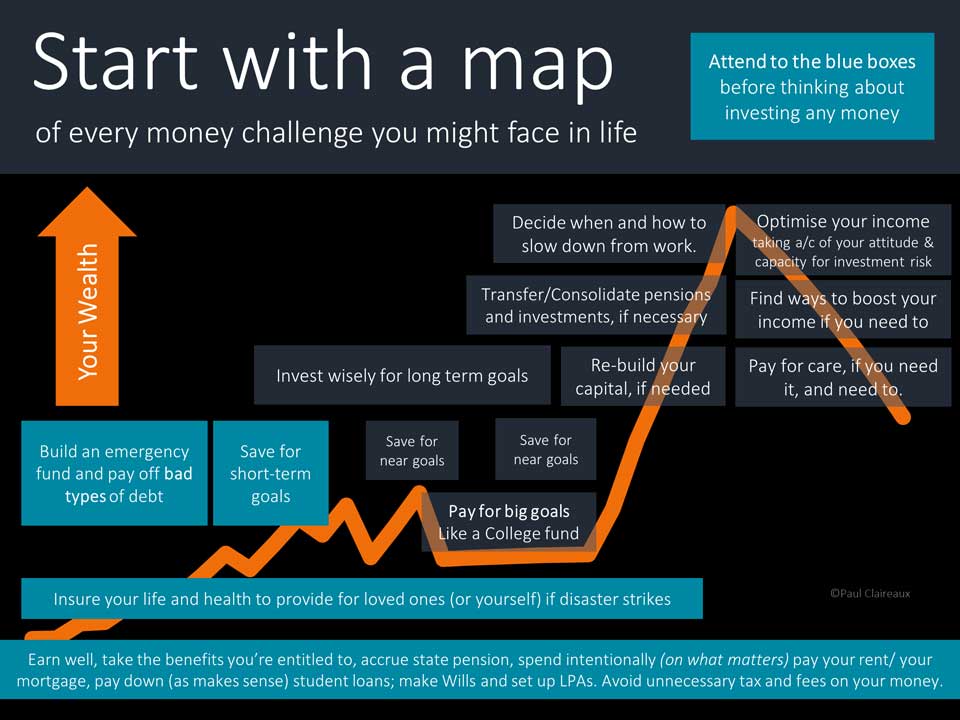
So, while you do not need to deal with these challenges all at once, it’s worth knowing that most people face them at some point in their lifetime.
And if you don’t yet have a plan to approach them in the right order, it’s worth seeking help from a competent financial planner – who will ensure you get your financial ducks lined up, as part of your financial life plan.
Why is retirement income planning so different from your other financial life goals?
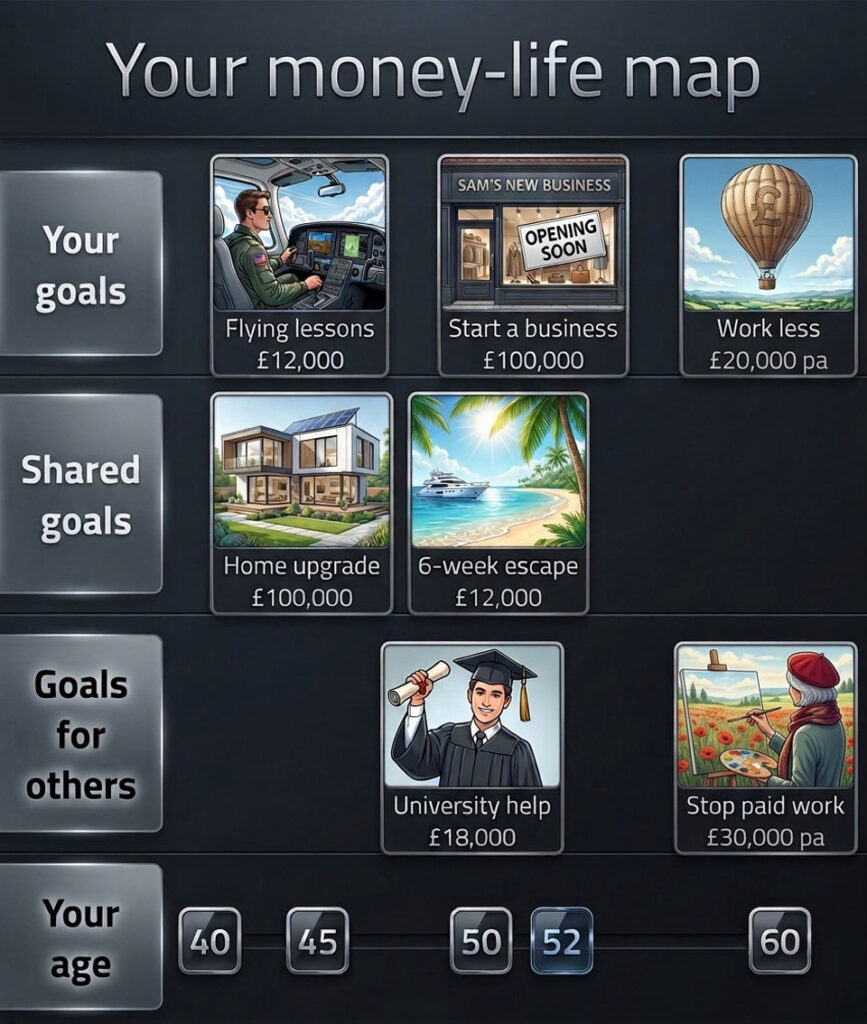
You can probably put a price tag (in today’s money terms) on most of your big financial life goals.
You might know you want to have £18,000 set aside to help one of your children through college in a few years’ time.
Or that your planned, once-in-a-lifetime, six-week holiday for your 50th birthday will cost £12,000 – in today’s money terms.
You save (or invest if there are several years to your goal) to build the desired amount – then you spend it on yourself or your loved ones – and sometimes on both.
It’s not very complicated.
But your plan to have enough to stop or slow down from work isn’t as simple. There’s no obvious single number to save towards.
What you’ll need is a flow of income that arrives every year for as long as you live.
Of course, you cannot know how long that will be, but you can look at the averages.
According to the Life Expectancy Calculator from the Office for National Statistics, the average 65-year-old male will live to age 85, and more than one-third will live beyond age 90.
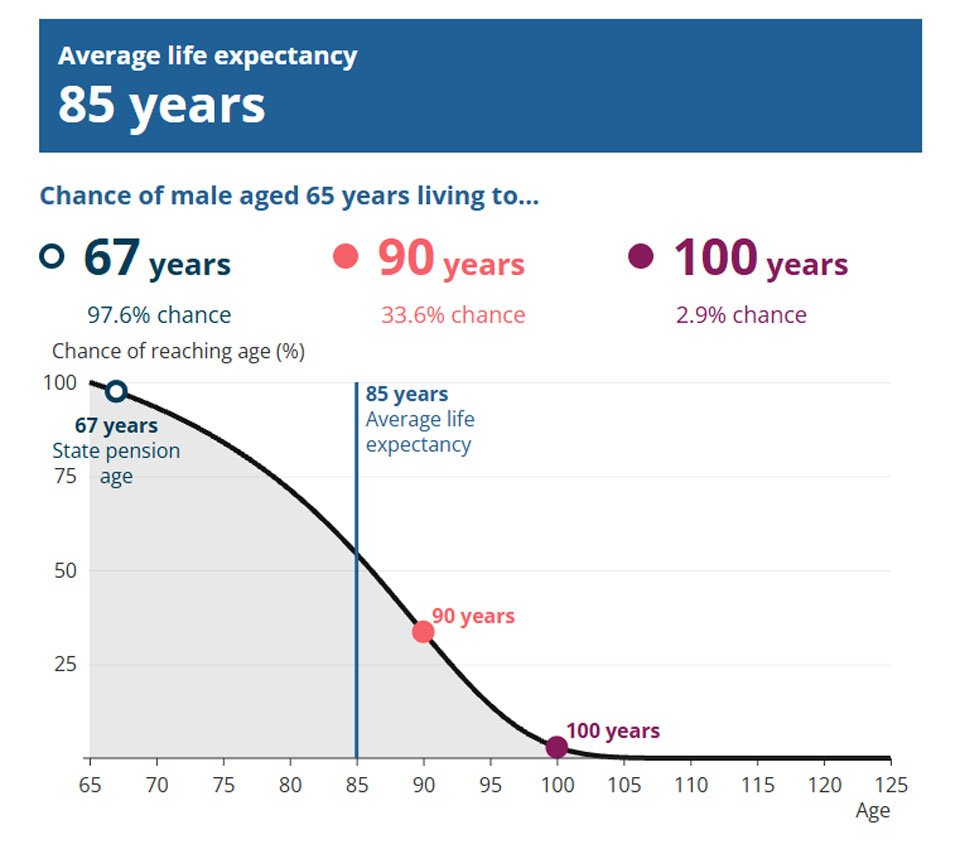
The average woman is expected to live to age 87 – and more than 45% are expected to live to age 90.
So, there’s a good chance you’ll need a retirement income stream that lasts for 20 to 30 years – or longer if you retire earlier than age 65.
And over that time, inflation can erode a lot of your income’s purchasing power.
If inflation continued to average 2.7% pa. as it has done over the past 20 years, a fixed amount of income starting today would buy you c. 40% less in 20 years’ time.
This is why the State Pension is adjusted each year to protect against inflation.
The question is whether (and to what extent) you also need to protect your private pension income flows from inflation.
Is it expensive to protect your retirement income from inflation?

This question might not worry you if a large slice of your (non-state) pension income will come from ‘Defined Benefit’ (DB) pension schemes.
Those schemes, as their name suggests, define the benefits you receive.
And, for the benefits you’ve built up since 1997, they must provide a degree of inflation protection on your retirement income payments.
(Some schemes offer that protection to all your pension payments – regardless of when you ‘accrued’ them)
So, it’s vital to study your pension scheme booklet(s) and statement(s) for details. And be sure to consult a professional adviser if you need help.
The documentation around these schemes is often full of gobbledegook!
DB pension schemes are still widely available in the Public Sector, but there are very few DB schemes open to new joiners (or even new accrual) in the private sector, where Defined Contribution (DC) schemes are the norm.
With DC, only the contribution (from you and your employer) is defined. So, the eventual size of your pension income depends on the growth of your chosen investment funds inside your pension pot – and the ‘rate’ at which you’re able to convert that pot to income when you take the benefits.
And the truth is that your starting ‘rate’ of income could range from 4% to 8% of your pension pot, depending on:
- The type of product you use to generate income.
- The degree of inflation protection you want.
- The assumptions you make about future investment returns if you keep your pension invested.
- The likely Bumpiness in the value of the investments in your pension pot.
Making the right choices on financial products and investment funds at the point of retirement is widely agreed to be the hardest of all questions in personal finance.
So, ask a competent financial planner for guidance when you approach the time to withdraw money from your pension plans.
For now, just be aware that your assumptions about the future ‘pot-to-income’ conversion rate will make a big difference to the estimated cost of your plan.
Let’s say you want to have an extra £10,000 a year of income in retirement.
If you assume a 4% conversion rate, you’ll need an extra pension pot of £250,000 – in today’s money terms.
However, if you assume a 6% rate (which might also be reasonable, especially for an income with less inflation protection) your required extra fund falls to c. £167,000.
And that reduction of £83,000 in your target fund could make an enormous difference to the amount you need to save/invest now to build that fund.
Can we super-simplify retirement income planning?

Perhaps you’re now thinking that this retirement planning malarkey is simply too hard to undertake on your own.
And it’s true to say that this difficulty in making ‘reasonable’ assumptions (about the ‘income’ conversion rate at retirement — and the growth on your funds before retirement) has led various people to devise simple ‘Rules of Thumb’ for funding retirement.
The problem is that those Rules of Thumb simply don’t work and we cover why in this companion Insight
which is worth reading to see why it’s essential to have a simple but robust approach to designing your plan.
Retirement income planning is also hard because most people have little idea of the future income flows they’ve already built up (or accrued, as they say in the pensions world) from the State Pension, old pension plans or even from their current scheme.
This information should all be available to you, however, in your statements from old workplace pensions, your current scheme, and your State Pension forecast, which you can obtain from here.
So, dig out your pension statements and request new ones if any are missing over the next few days, because you’ll want them for the layer cake drawing exercise when we get to that.
Should you plan your retirement income alone – or as a couple?

Again, to keep this exercise simple, we’ll show you how to create a retirement income map for your personal needs and wants.
Of course, if you share your home with a partner when you stop or slow down at work, you’ll potentially be much better off than your ‘solo’ plan suggests.
You might save thirty to fifty per cent on your essential bills – and on other significant costs if you can share the use of one car, for example.
On top of that, if you’ve both built up National Insurance records, you’ll have two State Pensions coming into your home, rather than one.
And you’ll have two personal income tax allowances. So, you’d be able to enjoy c. £25,000 of income, as a couple, before you pay any tax each year.
Add that all up, and a couple aiming for a moderate or comfortable standard of living may each need only half the private pension that a single person aiming for the same lifestyle would need.
So if you have a partner, it’s worth doing this retirement income planning exercise together at some point.
We simply suggest you do it alone first so you can assess your situation more quickly than ‘waiting for a good time to talk about this’!
You can always come together, to work out how much better off you’ll be with a joint plan – and shared living costs, later on.
Can you plan with numbers in today’s money terms?
Yes, absolutely – and this is key to building a plan that’s easy to understand.
We’ll offer more guidance on how to estimate your future living expenses in the next Insight.
For now, ignore how inflation will affect these costs over time – we’ll deal with inflation later.
Just think in today’s money terms because those numbers will feel real.
If you want to get clever when you’re close to retirement, you could try to account for different rates of inflation on different expenditure items.
Just be careful you don’t tie yourself in knots of unknown numbers or by aiming for perfection on your first attempt at drawing the picture of your retirement income slices.
Our aim with this series is to show you how to draw a rough picture that helps you see:
- The income you might need when you stop working or slow down.
- The slices of that income you’ve already built up (and are on track to build) with your (state and private) pensions and other investments.
This will give you a clear view of the gaps (if any**) you need to fill, and your options for filling them.
** The sooner you start this exercise, the better. If you’re younger, starting early reduces the cost of filling gaps in your plan compared to starting later. And if you’re in your 50s or 60s, you may even find there’s no gap, and you have enough to retire now!
The good news is that most pension statements already show projections in today’s money terms.
So, once you’ve found them, it should be relatively easy to add them to your layer-cake picture of your future retirement income, as we’ll see in the next couple of Insights.
What have we covered and what’s coming next?
In this insight, you’ve seen where retirement income planning fits with your other financial life challenges — and why it’s more complicated than you might think.
We’ve also pointed you to our companion article on why oversimplifying this exercise (with ‘Rules of Thumb’) doesn’t work.
What you now need is a handle on the income you’ll need (and want) from your pension and other investments when you stop or slow down from work.
And that’s what we’ll explore in the next Insight.
See you in there when you’re ready for that