Four retirement planning rules of thumb that mislead you
And a ‘rough’ guide to retirement that actually works.

If you ask ten people how they plan to have enough money to stop or slow down from work, you’ll probably get several blank stares and a few tentative ‘Rules of Thumb’—which don’t actually work!
How many people know whether they’ll have enough?
The blank stares are well documented.
When the Department for Work and Pensions surveyed more than 4,000 people aged 40 to 75 in 2024, 41% said they had no idea how much income they’d need in retirement.
And yet that is the first number you need in any retirement plan.
The second number is the income you’re on track to receive – and the picture is similar.
In 2025, Standard Life found that nearly half of UK adults (47%) don’t even know how much they have in their pension savings!
So, around half of people can’t answer one or both of those basic retirement planning questions.
And it’s unclear how many others have even a roughly accurate picture.
The problem is that people around the world are given ‘Rules of Thumb’ that promise a shortcut to this challenge.
This Insight exposes those Rules of Thumb for the ROT they are. And it points you to a proper approach to retirement planning that you can start mapping out on one sheet of paper at home.
This is a 5 to 10 minute read – depending on your speed.
What’s coming up?
Here, we’ll outline four quite common but misleading rules of thumb (ROT) you might find if you look for guidance on retirement income planning.
We’ll show you exactly how each ROT fails, using worked examples and point you to our Rough Guide to Retirement, which shows you how to build a plan that works — and is personal to YOU.
For the first 3 of these examples, we’ll use ‘Sam’ as our case study.
Sam is 35, has no retirement savings yet, earns £39,000 a year (the median level of full-time earnings in the UK) and wants to target a gross retirement income of £20,000 a year from private pensions (or £33,000 a year, including the New State Pension), from age 68.
Sam has done her homework and knows that, in today’s terms, £33,000 a year before tax should get her close to a ‘moderate’ standard of living in retirement, assuming her mortgage is repaid by then.
Sam would love to stop or slow down from work before age 68, but knows her State Pension of around £13,000 p.a. (2027-28 figures) will not start until age 68.
So, Sam is happy to make an initial plan on this basis and fund any earlier retirement ambitions later if she can afford it.
Let’s get into these misleading Rules of Thumb now.
ROT #1: Use very cautious assumptions
This ‘Rule of Thumb’ error is less common now – but it used to appear constantly in the money pages of newspapers, including the better-quality ones.
What’s the problem?
A journalist, looking for a table on “the cost of funding retirement,” would ask a financial planner for the numbers.
And in many cases (perhaps to deter criticisms that they were making over-optimistic assumptions) the planner would be excessively cautious – on both the assumed growth rate of the pension pot and the ‘pot to income’ conversion rate.
Sadly, the resulting tables published in some papers frighten many people off from saving anything at all!
This table shows the problem.
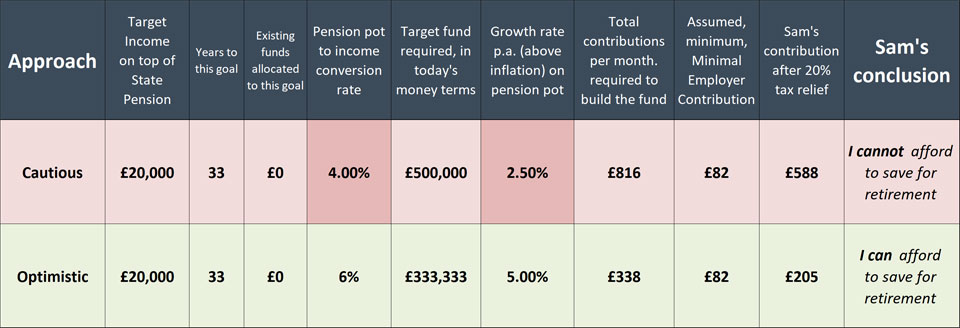
To be clear, the assumptions for both rows could be reasonable depending on prevailing interest rates and the pension planner’s age and attitude to investment risk.
However, in Sam’s case, the double caution on two assumptions has resulted in a cost estimate in the top row that is nearly three times that in the second!
Stacking caution on caution makes even modest retirement goals look unaffordable. And that defeats the purpose of this exercise, which was to encourage Sam to save something rather than give up on her plan.
ROT #2: The 300 times target income rule
On the face of it, the assumptions of this Rule of Thumb are broadly OK.
The idea is to:
- Multiply your target monthly retirement income by 12 for an annual figure.
- Multiply that number by 25 to find the pot you need to generate that income — assuming a 4% pot-to-income conversion rate.
4% is 1/25.
And 12 x 25 = 300.
We could argue for a factor of 240 (which assumes a 5% income withdrawal rate) in some cases, but 300 is also acceptable.
So, the problem with this ‘Rule’ is not the Maths.
The problem is that those who promote it often overlook the State Pension in their calculations, which introduces a major error in your plan, as this table shows.