How to plan your retirement income on one sheet of paper
Part 3 of the Rough Guide to Retirement
This is the third Insight in our four-part ‘Rough Guide to Retirement’.
If you’ve not read the first two parts, start there.
Alternatively, if you’re following this series closely — to learn how to sketch out your own retirement income picture — you’ll be making good progress by now.
By the end of Insight #2, you’ll have set your target retirement income (in today’s money terms), drawing on solid research data to create your personal spending plan.
You’ll also have your pension statements ready and have obtained a forecast of your state pension entitlement.
So, in this Insight, you’ll see how to turn those numbers into a layer-cake picture of your retirement income – on one sheet of paper. And this will help you see, at a glance, whether you’re on track to hit your target.
This is a 10- to 15-minute read, depending on your speed, but we suggest you set aside a good slice of time to sketch out your layer-cake picture.
You can also download our companion workbook for a 10-step guide to this drawing exercise.
What technology and apps will you need?

All you need is a sheet of A4 paper and a pencil. No need for another app on your phone or a complicated spreadsheet!
You can use a ruler if you like, but this picture will work just as well as a rough sketch. So, don’t worry about making it neat.
Rough or ruled, you should find the picture that YOU draw is worth more than a thousand words — or a table full of numbers. And it will help you spot what, if anything, is missing or when your plan needs to change.
Ready to start sketching your picture?
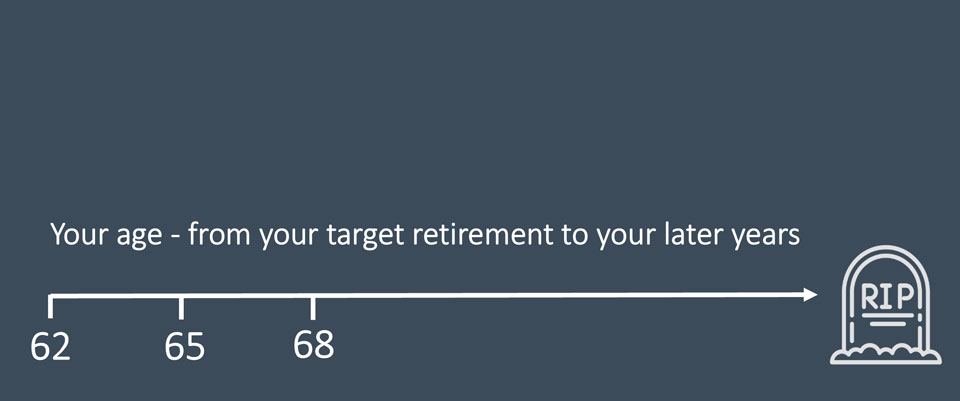
Start at the bottom left of the page, and draw a line across to the bottom right, with an arrow at the end.
This is your timeline running from your target retirement age into the future.
Now mark three ages on that line.
The first is your own target retirement age.
Chris used 62 here, but yours might be anything from your current age to age 68, or later.
It’s just a first estimate, and you can change it once you see how your page fills in.
The second is the age from which you think you’ll start drawing on any workplace or personal pensions.
Chris used 65 here.
Note: You don’t have to take your tax-free cash and pension income at the same time, as you’ll see later.
You choose the age at which you start drawing benefits — subject to any minimum access age that applies to you in your own pension schemes.
The normal minimum access age is currently 55 for most modern, flexible pensions, rising to 57 from 6 April 2028.
If your 55th birthday is before that date and you may want to access pension funds before age 57, it’s worth seeking advice, as the transitional rules can be complex.
Some people will retain a right to access benefits from some pension schemes before 57, and the Ill-health rules may also allow earlier access.
Many people see the age restriction on access to pension funds as a positive! After all, having no access to these savings in the near term means you’ll have substantially more savings available when you need them to slow down or stop work in your later years.
The third age to note on your retirement income picture is your State Pension age.
State Pension age began rising from 66 in 2026 and will reach 67 by April 2028.
The Government’s current policy position (noted by the Office for Budget Responsibility in 2026) is to gradually increase the State Pension age from 67 to 68 between 2037 and 2039.
Chris is 45 years old – and therefore expects his State Pension age to be 68.
Check your state pension
You can check your expected State Pension age and the amount you’re forecast to receive at https://www.gov.uk/check-state-pension or via the HMRC app.
It only takes a few minutes to check.
From there, you can identify any gaps in your National Insurance record (which might lower your expected state pension) and the cost to fill them. Then decide if those extra NI payments are worth making.
Can you move these dates?
Remember, you can change your target retirement age later.
You may be able to start income payments from your (non-state) pensions earlier (or later) than the ‘normal’ age shown on your pension statements.
The normal pension age is just a planning date. It’s not, normally, the date your employer asks you to retire.
Nowadays, most people can choose when to retire, although a small number of jobs do still have legally justified compulsory retirement ages.
Many people now draw some workplace pension before they’ve fully retired, or well before their State Pension arrives – while others do the reverse.
For now, mark the ages where you think you’d like them to land.
And note that while you can defer taking your state pension for a higher payment, you can’t take it before your state pension age.
Then, on the far right of your retirement timeline, add a symbol to mark its end, however you want to picture it!
Nobody knows when their life will end, but if you’re in average health and under 60, it can be worth planning as if you could live to age 90.
Now draw your target income on the page
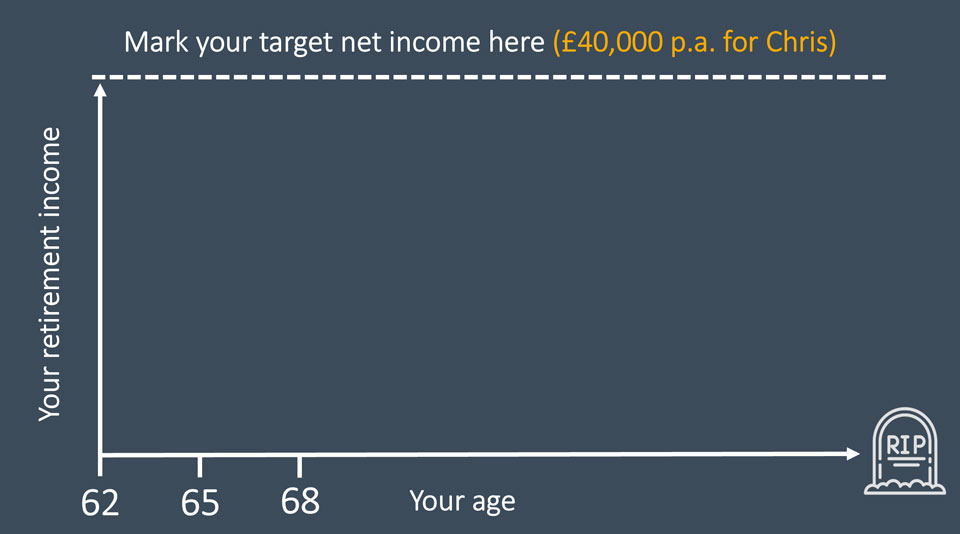
Now draw a dotted line running horizontally near the top of your page to illustrate your total target (net) income for your later years.
Label this line with your target number (in today’s money terms), as you worked out from the previous Insight.
Chris’s line is labelled £40,000 – yours should show your number.
You should now have a page with a line at the base with three ages marked on it, an end symbol, and a dotted target line at the top.
Now let’s start filling in your picture…