
Five (more) reasons we don’t talk about money
and how to overcome these blocks.

A 10 to 20-minute read, depending on your speed.
This is the second of two Insights for anyone who struggles to talk about (and deal with) personal money matters.
And that’s most of us at times!
Here, we’ll explore another five (of ten) reasons we might find it hard to talk about money, whether with close friends, family or a financial professional.
You can read the first five reasons we don’t talk about money here
Could there be more than ten reasons?
Yes, absolutely.
There may be many more reasons why we don’t have productive conversations about money – and if you struggle with this, for these or other reasons, we’d love to hear from you.
We’ll happily (and anonymously) add more blocks to our lists when we revise them.
Of course, sound financial education enables us to make better money decisions.
And we’ve known for 50 years (from the work of psychologist Albert Bandura) that we’re more likely to deal with challenging tasks when we feel more capable of engaging with them.
So, let’s continue with our list and explore reasons 6 to 10 for why we don’t talk about money.
Reason 6: We have an unhelpful attitude to money

Most of us form attitudes to crucial life questions based on flawed or incomplete information – at various points in our lives.
Forming binary (good or bad) views on most topics is easy, as we can see on Social Media, where such attitudes undermine useful conversations.

It’s worth knowing something about ‘attitudes’, which Psychologists describe as having three (ABC) components:
- A reminds us of the Affective component: how our feelings affect our attitude – and vice versa.
- B is for the Behavioral component: our behaviour affects our attitude – and vice versa.
- C is for the Cognitive component: what we believe and know (about the ‘thing’ under discussion) affects our attitude – and vice versa!
The letters ABC are certainly easy to remember, but we doubt many people remember what those psychology-technical terms stand for.
And thinking about the ABC elements in that order may not be the best way to change our attitudes where we need to.
It seldom helps to start by focusing on how we feel about an issue – as that can lead us to justify our thoughts.
Often, it’s best to start with ‘C’ (the Cognitive component) and fact-check our beliefs to ensure we don’t fall into this thinking trap!
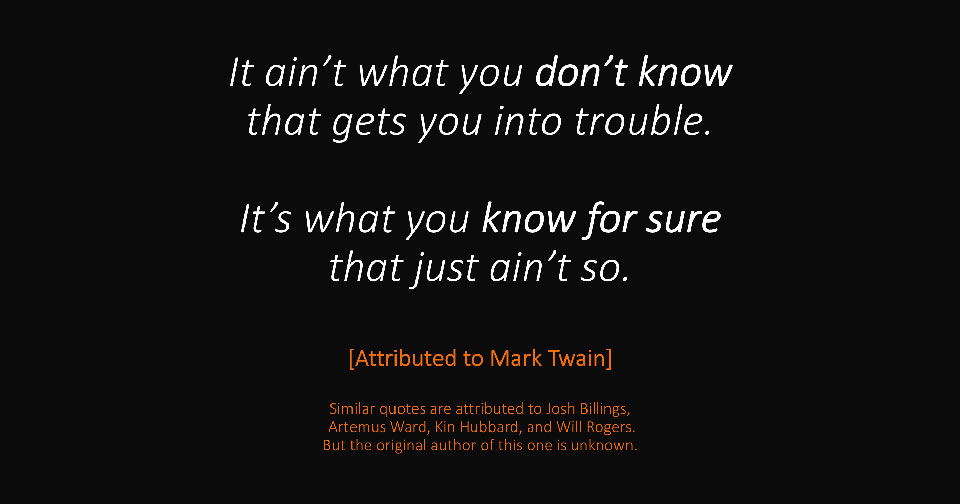
It seems that Mark Twain (or others) observed the Dunning-Kruger effect – mentioned in the first of this two-part series many decades before the researchers found it!
We can all think of examples where changing a flawed belief could improve someone’s life or the world – so let’s keep this language simple.
An ‘attitude’ is just a package of beliefs and thoughts – and the emotions and behaviours that typically result.
And the good news is – we can change our attitudes.
We acquire our attitudes from what we learn – at home, at work and in our local and online communities.
So, we can unlearn these attitudes, too – if we need to.
Each of us has our own unique mix of (positive, neutral or negative) attitudes towards most things.
For example, how do you think, feel and act towards (and talk about) the following:
- Your role and hours at work.
- Your boss or another colleague at work?
- The behaviour of loved ones at home!
- Government policy – on health, education, transport or policing, for example.
- The behaviour of those in different political or religious groups.
The list is endless, and our attitudes to various money questions vary enormously.
For example, you might believe (or not believe) that:
- It’s essential to save for a rainy day.
- It’s important to insure your life and health against an unexpected disaster.
- There’s value in taking professional advice.
Just be aware that it can be extremely challenging to change some of our attitudes, particularly those we learned in our younger years.
It was then, for better or worse, that we first formed many of our attitudes to the big questions: about work, money, health and relationships.
So, please be patient and kind to yourself if you’re striving to change some of your attitudes.
And remember, with regard to our money-life experiences:
- We seldom learn much from getting lucky with money.
- We don’t always learn good lessons when we’re unlucky, either!
So, it’s worth learning the essentials about money in a safe environment like this – rather than taking big risks on things you don’t understand.
Reason 7: We’re embarrassed to talk about money


For financial advisers, planners and coaches
This educational Insight is one of many we’ve created for you to use under license in your business to help more people make better financial decisions – and see the value of professional advice.
You can brand these licensable insights to your business style and add your own firm’s calls to action.
If you have any questions at all, please email me at hello@paulclaireaux.com
For financial advisers and coaches
To use this or other educational insights in your business.