
Does your content need a good SCAN?
Is it working hard enough for your business?

On this page, you’ll learn about a valuable NEW content scanning service
The service is designed primarily for financial planning/advice business owners offering educational Insights on Money (and Money Psychology) topics.
However, it could also help you if you offer other professional services in this or other sectors.
The aim is simple: to help you obtain more bang for your marketing bucks.
This is a 10-to-20-minute read – depending on your speed.
Are you keen to change this picture?
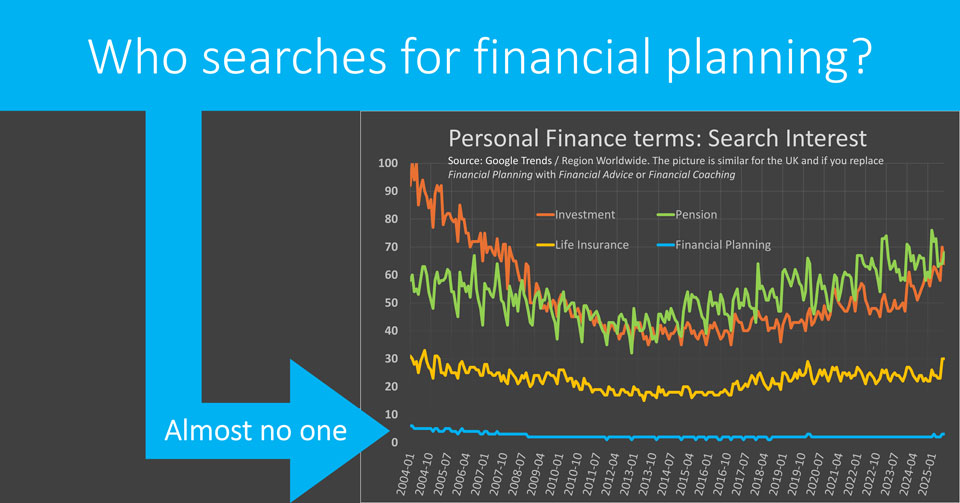 Your firm may be very different to most, but I imagine we can agree that financial advice/planning (as a service) has a massive image problem.
Almost no one searches for it, which suggests very few people (other than clients and people they refer) have a clue about the value of what you do.
Incredibly, that blue line has gone down over the past 20 years!
It’s also on the floor if we replace Financial Planning with Advice or Coaching, or we look at search data for the UK or the USA alone.
We also know that ‘Financial Services’ has been stuck near the bottom of the Edelman Trust Barometer for many years. (ask me if you’d like to see that data)
And then there are other studies – from Schroders, UBS and Cerulli (U.S.A) which show c. 70% of inheritors (spouses and adult children) plan to change advisers when the main wealth holder dies.
So, if you need (and want) to lift that blue line for your business, this page is for you.
This is about repositioning your services in NEW (more focused and fascinating) ways with content that passes these ABC tests.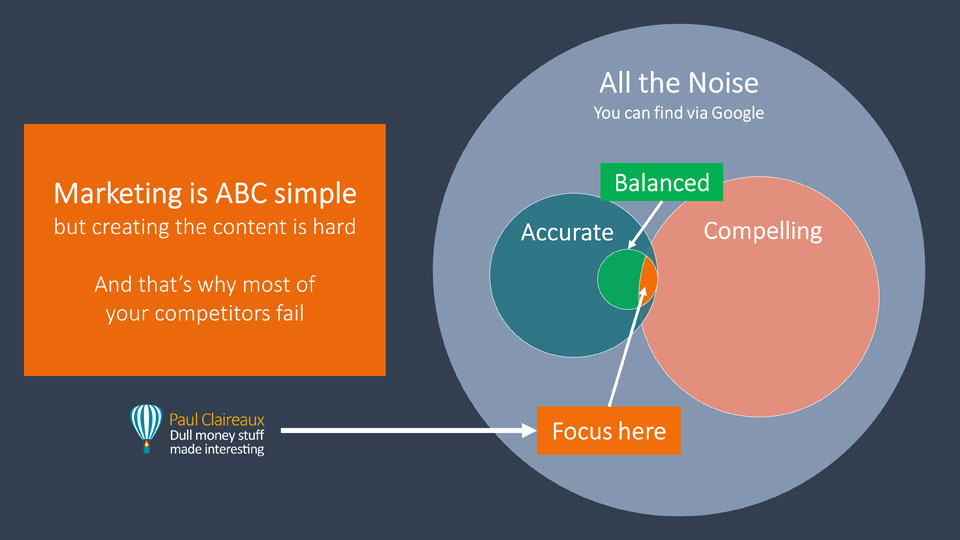
Do you need to raise your content game?
Well, as Henry Ford (allegedly) said:
If you always do what you’ve always done, you’ll always get what you’ve always got.
Then there’s Einstein, who is often attributed as saying:
The definition of insanity is to keep doing the same thing and expect different results.
Although what I think he said was: “We cannot solve our problems with the same thinking we used when we created them.”
And here’s my favourite quote on the need for constant personal change, from (the extraordinarily resilient) Viktor Frankl:
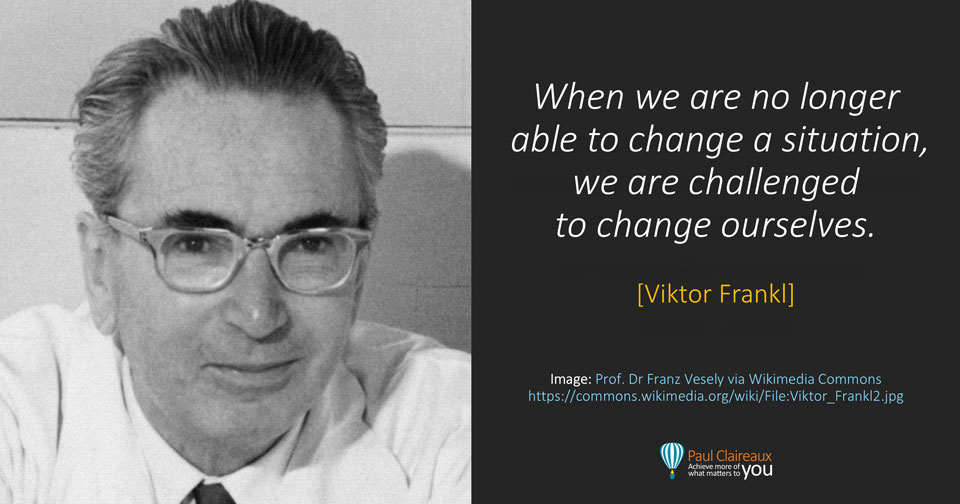 Viktor Frankl was an Austrian Jewish psychiatrist who survived three years in Nazi concentration camps, where he lost his parents, brother and pregnant wife, along with the manuscript of his life’s work.
I recommend his classic book, ‘Man’s Search for Meaning’, which shows how purpose and inner freedom can sustain us even during times of extreme suffering
Do you make any of these mistakes with content?
 Perhaps you’re knocking it out of the park with outstanding Insights – helpful, engaging and educational content that grabs the attention of, and builds trust with your current and future potential clients.
Either way, I’d hope we can all accept that our content (like a draft manuscript for a book or an early score of some music) can always be improved with care and attention from another skilled creator.
What’s clear (from that data above) is that the billions of pounds/dollars spent on marketing (across the FS sector) is failing to engage people in financial planning.
And I think that’s a tragedy, given the potential life-changing value of your services.
So, it makes sense to ask this question.
How must your content design change – so it attracts and engages more consumers?
Take a minute to study the list below and, if you dare, share the list with colleagues and friends.
 Would you (or they) say you have any content on your website that:
- Is painfully dull and has no clear audience – other than the writer?
- Is mostly technical or numerical – with little appeal to people’s emotions?
- Has no discernible call to action?
- Contains long sentences and never-ending paragraphs?
- Lacks structure or flow, like a random stream of the writer’s thoughts?
- Fails on any of the six elements of writing style? (More on those below)
- Is filled with jargon and undefined TLAs? *
- Contains confusing and ambiguous messages?
- Leads with personal beliefs and makes inaccurate claims on objective facts?
- Claims simplicity on complex and nuanced issues?
- Contains no (or poor quality or copyright-infringing!) images to bring the work to life?
- Offers charts that require a magnifying glass to read and a genius to interpret?
* Sorry about that, I meant to say three-letter acronyms 😉
Now I accept that’s an extreme list of problems!
Yet you and I know there’s a ton of content out there (from financial advice and other service firms) that fails in one or many of those ways.
Why do these content problems persist?
There are many drivers of poor-quality and dull content.
In broad terms, however, it’s produced by writers who lack the necessary skills, knowledge and passion for their subject – and who don’t dedicate (or are not given) nearly enough time to create outstanding works.
A lot of the best content is also especially relevant to a particular audience. And a common mistake is writing content with no audience in mind.
It’s hard to craft a set of words and images to ‘fascinate’ a group of people when you’re unsure who you’re talking to.
Imagine someone doing that in a live presentation.
And yes, OK, if you’ve worked in a big corporation, you don’t have to imagine!”
Is this about niche marketing?
No – this is not about defining a niche (client type) market for your services.
Firms offering holistic financial planning don’t (necessarily) need to do that.
After all, like your friendly GP or your local car driving instructor, there is a broad market for some services.
Remember, there are two ways to niche your services.
You can niche by client segment, by the services you offer, or both.
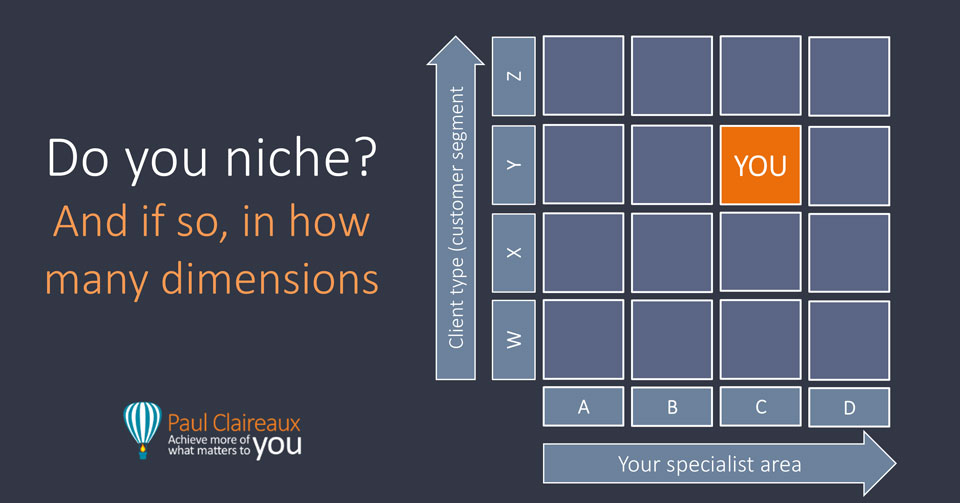
Similarly, with your educational content, some Insights (on foundational concepts) may have universal appeal, while your specialist content may dive deeper into the money challenges of a narrow group of people, like:
Doctors, Dentists, Divorcees, Dancers, Data Engineers or Detectives!
Or others beginning with other letters!
So, whether you aim to serve a niche market is not the main issue with content.
Or do you assume your audience knows what you know?
The biggest failures arise when the content is rushed.
And, when content is rushed we typically fall into the TRAP of assuming our audience knows much of what we know.
Have a look at these 8 fundamental questions about financial planning.

I imagine you could give sensible and complete answers to most of those questions while standing on your head!
Although you might need to think hard about questions 7 and 8.
And they’re essential for selling the value of personal financial planning.
Content failures arise when we assume our audiences know all those basics, too.
Or that they are the least bit interested in all the technical details behind them!
And yes, some marketers make the same mistake in assuming that financial planners know all about marketing.
The truth is that very few people are specialists in multiple domains.
Who are you writing for?
Many of us start writing to explore and expand our own knowledge.
We’re keen to better understand ourselves, the people around us, and the world we live in.
So, at least initially, we may tend to write about topics that interest us personally.
And we’re in very good company in doing so.
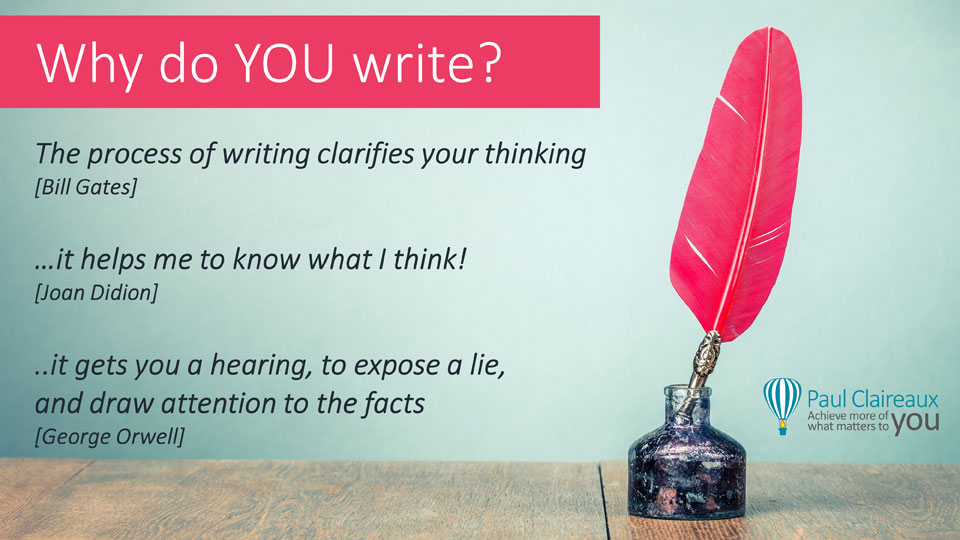
Funnily enough, George Orwell offered lots of advice on how to write to be understandable and engaging.
He urged us to avoid using long or fancy words.
Fancy words don’t make us sound more intelligent – only clear, concise and concrete words can do that.
And recent research backs this up.
Nielsen (the ‘User Experience’ experts) found that even highly educated professionals (scientists, medical experts, technologists) favour clear and scannable information.
Others, who led the work to redesign GOV.UK discovered that:
the more educated the person and the more specialist their knowledge, the greater their preference for plain English.
Have you noticed how the DotGov website is a much easier read these days?
Orwell said, ‘Never use a long word where a short one will do’
And his editing rule was this:
“If it is possible to cut a word out then do so. Cut out anything that doesn’t earn its place on the page”
The challenge for all of us (lifelong learners who’ve passed some advanced financial planning exams) is that we’re building on a broad base of knowledge.
And it’s easy to forget that most people we write for, while possibly experts in other matters, don’t know a fraction of what we do on our subject.
So, you must create (or acquire) content that helps your audiences build their knowledge and skills (and thus their confidence to engage with your services) in small, plain English steps.
Why is this so hard to do?
 The ‘Curse of Knowledge’ describes this immense challenge.
It’s extremely hard to imagine what it’s like to be someone who doesn’t know what you know.
And this curse causes all sorts of poor communication (and relationship problems) on issues big and small – both in our work and home lives.
To learn more about it, listen to Professor Steven Pinker if only for the first 5 minutes of this interview.
The curse of knowledge is a classic assumption error.
We assume others know as much as we do.
And if most of your content (on LinkedIn, for example) is written to have a chat with your peers, that’s a fair assumption.
It’s just extremely unhelpful to assume that when creating ‘explainer’ content for consumers.
So, these communications must be very different.
How can you close the knowing-doing gap?
 Of course, it’s one thing to become aware of the Curse of Knowledge.
But, as with most behavioural biases, it’s almost impossible (on our own) to avoid the content mistakes that arise from it.
We might think our messages are clear when we write or speak, but too often others interpret them differently.
Thankfully, the solution is simple.
Get a coach!
Ask a proven content creator to critically review some of your works.
This will reduce or eliminate the risk that your content fails on the 12 points above – and others!
Perhaps you already have your content reviewed by family members, friends, fellow directors, or employees?
That’s certainly better than publishing without any reviews at all, as some clearly do.
And those people will hopefully have your best interests at heart.
However, they’re unlikely to give you a complete and honest assessment of your work.
After all, they may:
- Wish to avoid being critical for fear of offending you. And that’s particularly true with employees.
- Feel unqualified to comment on specific ideas or your writing style.
- Not have enough time to conduct a proper review in the timescale you need, esp. if you ask for your reviews to be done as a favour!
On the other hand, you may find that some family members are overly critical of aspects of your work, while being unqualified to provide you with a full review.
So, that’s not helpful either.
In short, the people close to you will struggle to tell you when your own works need more work!
And that could be costing you a fortune – in time, missed enquiries or even reputational damage.
You may never get to hear about all the great ideas (and style and format changes) you could make to benefit all of these people.
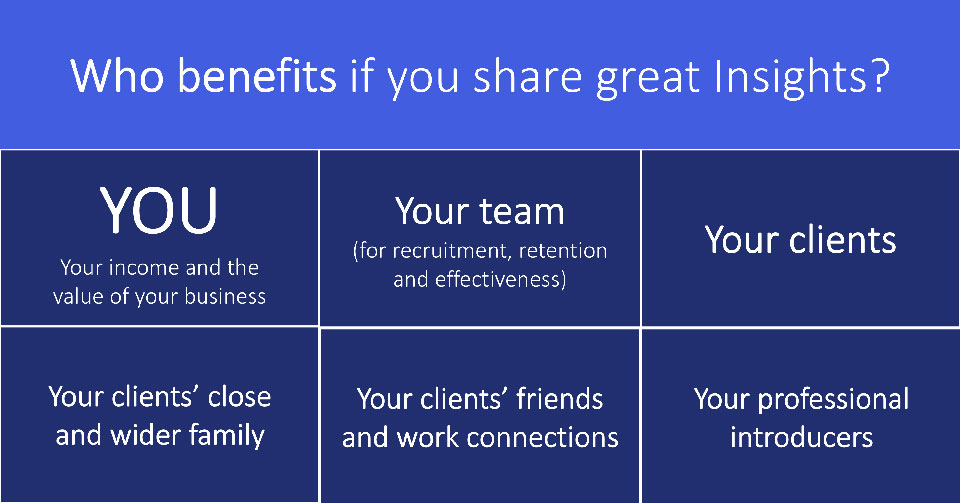 And that’s why I’m launching a service to give you those ideas.
This new SCAN service will tell you precisely what you need to know – with no holds barred!
What will this NEW service tell you?
This service will give you honest, complete and clear feedback on whether your content:
- Is insightful and engaging
- Highlights the value of your services.
- Will inspire your readers (or video watchers) to come back for more ideas or ask for advice.
- Is likely to build trust!
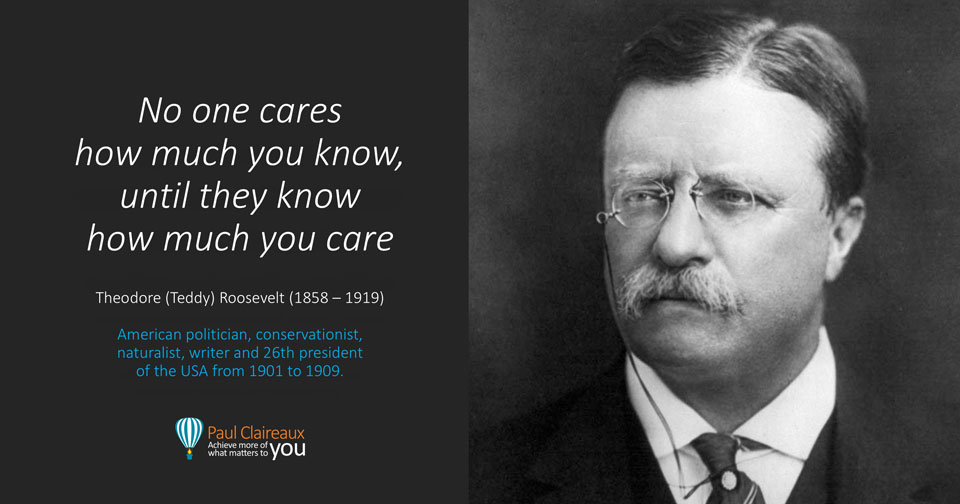
The research from the Psychologists shows that we put more trust in those who show their ‘warmth’ (good intentions) before showing off their competence.
Although you’ll note that Teddy had this Insight about 100 years earlier!

Your content must show you care about your client’s financial challenges before offering solution ideas.
This is about showing you’re interested before trying to be interesting!
What does this SCAN service cover?
 First, we’d need to agree that a content SCAN could deliver significant value to your business.
And I’m happy to have an initial chat without charge to explore that.
Only then, with your agreement, would I assess some samples of your content, which could include:
- Your signature posts/guides, if you offer those.
- Regular Social Media/website posts.
- Webinar presentation slide decks.
- Video explainers.
SCAN stands for Structure and Content Assessment Note.
So, you receive a personally presented and complete assessment with actionable improvement suggestions on the following aspects of your content:
Audience targeting and relevance: How well might your content resonate with the client?
Writing style: If you have style guidelines, it will help to know those, but I’ll assess your content against these proven elements of style:
- Point of View: Does it directly address the reader as ‘you’ and use both logical reasoning and figurative language?
- Tone of Voice: Is it distinct, confident, authoritative and professional while feeling personal, conversational and approachable? Does it use informal language and occasional anecdotes to build rapport, engage and fascinate the reader?
- Diction: Is the language simple? Does it avoid technical jargon? Is there any humour? Are there any relatable analogies?
- Syntax: Are there enough short declarative sentences, rhetorical questions, and lists to aid readability?
- Pacing: Does it mix a brisk pace with short paragraphs and frequent subheadings, with a slower pace for more complex ideas?
- Mood: Is it open, honest and understanding of challenges, while optimistic and solution-focused.
Readability and accessibility: Is the content easy to understand and navigate?
Emotional engagement: Does it motivate and resonate on a personal level?
Call-to-action effectiveness: Are the next steps clear and compelling?
Visual and multimedia use: Do any images and layouts enhance or undermine your messages?
Is there enough white space!
Accuracy, balance, and depth: Does the content contain any obvious factual errors? And is it well-rounded and sufficiently detailed?
Originality: Does it rely on old and tired stories or offer fresh perspectives?
Evergreen value: Is it likely to be long-lasting and minimise your content maintenance costs?
Additional Feedback on webinars and videos
 If you’d like me to review a video or webinar presentation, I’ll focus on the spoken words.
However, I will also provide feedback on:
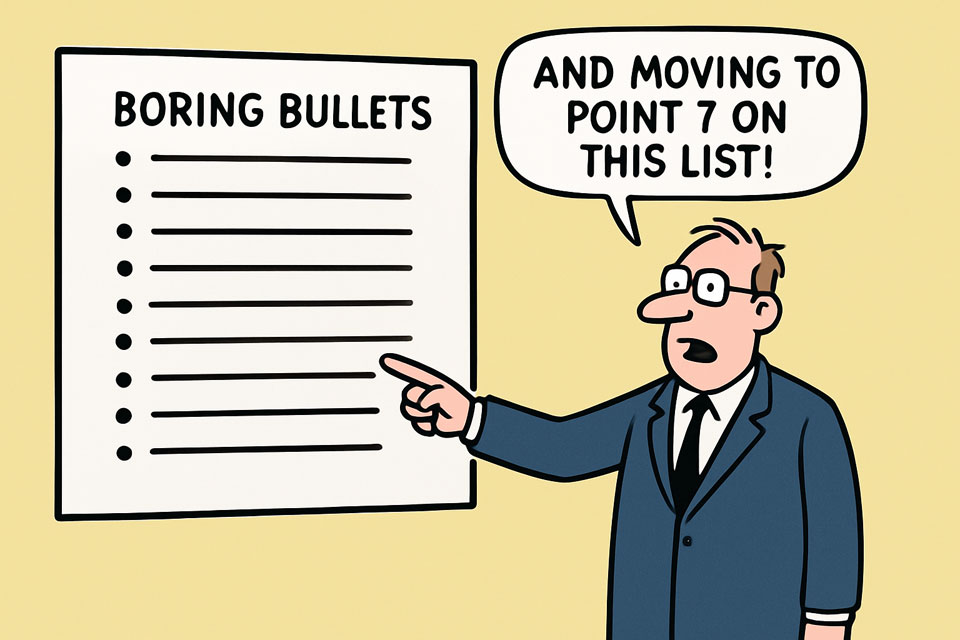
Slide design and integration: Looking for on-screen visuals (slides, graphics) that enhance understanding, are well-timed, free of clutter and long bullet point lists!
Audio quality and clarity: Assessing background noise, sound levels, and whether the spoken content is easily understood.
Audience engagement: Looking for interactive elements like polls, Q&A, direct audience address, and responsiveness during live presentations.
Video production quality: Look for good camera angles, lighting, resolution, transitions, and overall production quality to give your firm a professional image.
Accessibility features: Looking for captions and transcripts.
Story structure and flow: Assessing how well the introduction, body, and conclusion are organised to guide the viewer.
Call to action: Consider if viewers will know what next steps to take and be inspired to take them.
Emotional impact and authenticity: Assess the presenter’s delivery for authenticity, confidence, and ability to build trust with the audience.
What’s the cost of this content SCAN?

After an initial launch period, I will charge for this intense analytical (and value checking) work at around the same effective hourly rate as an ‘Average Financial Adviser’ – using fee scales estimated by VouchedFor.
However, for the first 10 clients who take up this new service, I’ll offer a 50% discount.
So, that’s an enormous saving on the cost of having a financial planning-qualified and proven content creator to conduct this assessment.
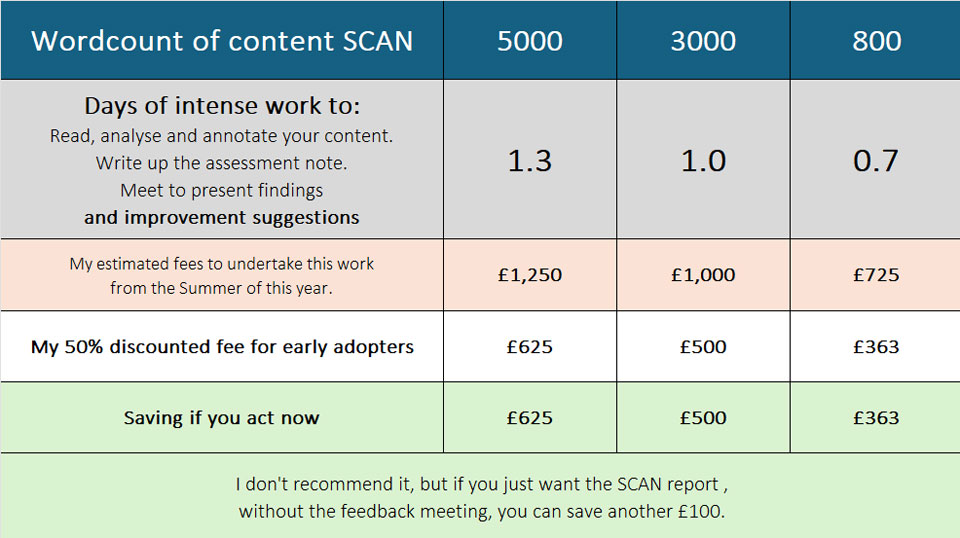
Actual fees will depend on the work involved, which in turn depends on how much content you want scanned.
I can advise you of my fee when I see the work you’d like scanned.
Examples are shown in this table.
These discounted fees for this SCAN service are payable in advance.
Why would you ask *me* to review your content?
The main reason is that I will add significant value (and potentially transform your future content marketing) by showing you all the key issues with your content… in confidence, of course!
Other than that, it may be because you’re familiar with (and like the style of) my consumer-facing educational works.
If not, please read some of those, like this one, on whether it’s worth paying for advice.
Or read this Insight (the first of three) on How to choose a good content creator.
You can also scan my testimonials on my about page here.
Note that I’ve already helped two firms reach the finals for a prestigious (Workplace Savings and Benefits) award as ‘Financial Educator of the Year’.
And I’m keen to help more.
Over the years (perhaps because I wrote an acclaimed book), several financial planners have asked me to review and give feedback on their work.
Some have even asked me to read and review their book manuscripts!
Those requests always make me smile because, as the table above shows, it would take 2 to 3 weeks of intense work to conduct a proper review of a (typically sized) 60,000-word book!
Without experience of writing, it’s easy to underestimate the time (and blood, sweat and tears) that goes into it.
It’s common to underestimate the time it takes to (thoroughly) review other people’s work, too.
So, in the past, I’ve had to decline these requests from anyone other than paying, contracted clients.
However, I am delighted to say, I can now offer this SCAN as a standalone service.
And this full SCAN and report back may be all you need to get your content flying.
How much do great Insight libraries cost?
If you’ve read this far, you can see there’s value in having independent and actionable feedback on your consumer-facing insights.
Acting on this SCAN could transform your marketing performance.
I’ll show you ways to minimise your content marketing costs too.
I know your cost options for building a (great) library of educational Insights.
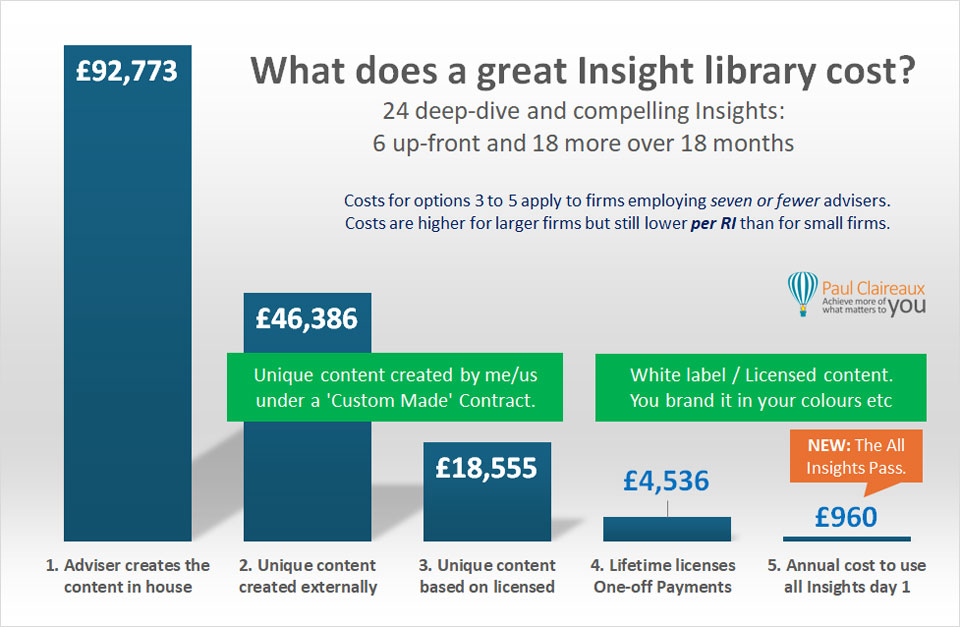 And to thrive in our increasingly competitive world (with super-low-cost Targeted Support services just around the corner), it’s essential that you spend your marketing budget wisely.
So, whether you create your content in-house or use external suppliers, I’m happy to SCAN that content and tell you, very directly, if I think it’s serving you well.
Think of this SCAN as high-impact coaching
 The second meeting in this SCAN service is effectively a one-off coaching session to help you build (or enhance) your educational library.
And this high-impact session could transform your business’s prospects.
What do you look for in a coach?
There are as many views on this as there are coaches in the world – and there are hundreds of thousands of those!
Dan Coyle, best-selling author of ‘The Talent Code’, suggests you should choose someone who:
- Listens intently to you.
- Genuinely wants to help you figure out what you want.
- Loves to teach the fundamentals of what you’re learning about.
- Can give you short, clear insights.
- And has plenty of real-life experience.
And that’s an excellent checklist for choosing a personal finance or content creation coach, right?
Who might you want to avoid as a coach?
I also agree with what Dan Coyle says here.
Avoid anyone who reminds you of a courteous waiter
Coaches who are too scared (or unqualified) to give us the feedback we need to raise our game can’t add much value to our business.
And they’re not good coaches if they only focus on keeping us comfortable and happy.
Yes, we all love the ‘likes’ on our social media posts.

The problem is, if we only ever hear praise, we’ve built ourselves an “echo chamber”.
And spending our time in echo chambers (or in flame wars with those who criticise everything we do) does not help us learn and grow.
We need challenging feedback for any magic to happen!
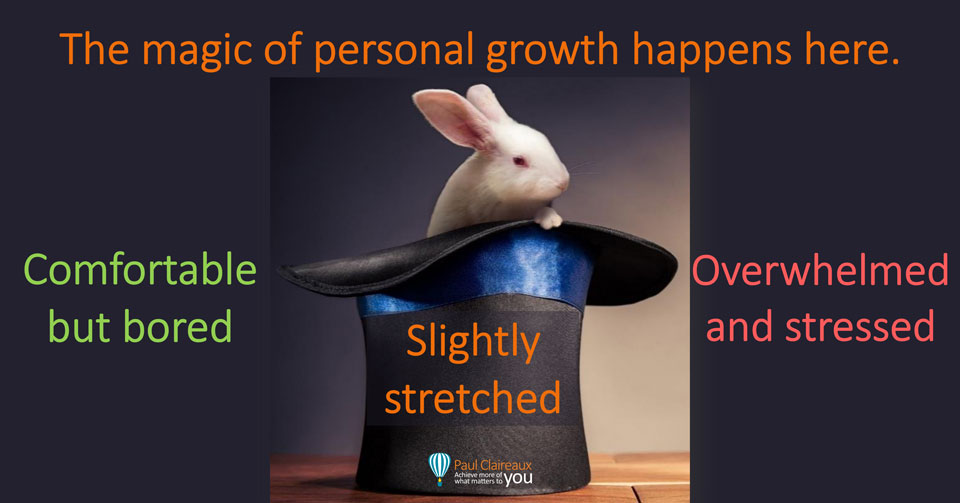 And that’s why it’s not always wise to have someone close to you as your coach.
They may be too ‘soft’ or too ‘hard’ on you.
Either way, they will struggle to provide the valuable and balanced feedback you need.
So, I’d urge you to find a coach with the qualities listed (from Dan Coyle) above.
I firmly believe that we all need someone to support us, and nudge us gently toward achieving more of the things that really matter to us.
That’s why those words are in my logo.
But please, don’t take my word for this.
Bill Gates (founder of Microsoft) said:
Everyone needs a coach.
It doesn’t matter whether we’re a basketball player, a tennis player, a gymnast or a bridge player.
We all need people who will give us feedback.
That’s how we improve.
And Eric Schmidt, former CEO of Google said:
Every famous performer has a coach.
Somebody who can watch what they’re doing and say, ‘is that what you really meant?’
A coach gives you perspective.
And that’s the one thing none of us are good at, seeing ourselves as others see us.
So a coach really helps.
So, if it’s not me, just be sure to find someone who is genuinely capable of doing that.
Someone who can give you valuable Insights into your content (and perhaps your wider business proposition), with compassion and good humour.
Someone who will leave you inspired and smiling at the end of each meeting.
Dictatorial dragons are best avoided.
And be warned – many of them end up as coaches!
Next Steps

If you’re happy with the terms outlined above, e-mail me with the content you’d like me to review.
I’ll take a quick look and tell you if a full SCAN would be valuable to you. And only where that’s the case will I suggest you have that assessment.
If you’d like to meet first to explore this new SCAN service or how else I could help you with your consumer-content needs, you can:
- Book directly into my diary here
- E-mail me at hello@paulclaireaux.com
- Connect with me on LinkedIn here – and message me from there.
I’m always happy to chat with business owners who want to help prospective clients make better financial choices.
Thanks for dropping in.
Paul
Discuss this article